
AI · Integration · Development · Consulting

Your operations, joined up.

AI agents, ERP and CRM integrations and custom tools for distributors, F&B and logistics companies.

We reply within one working day. No deck, no pitch.

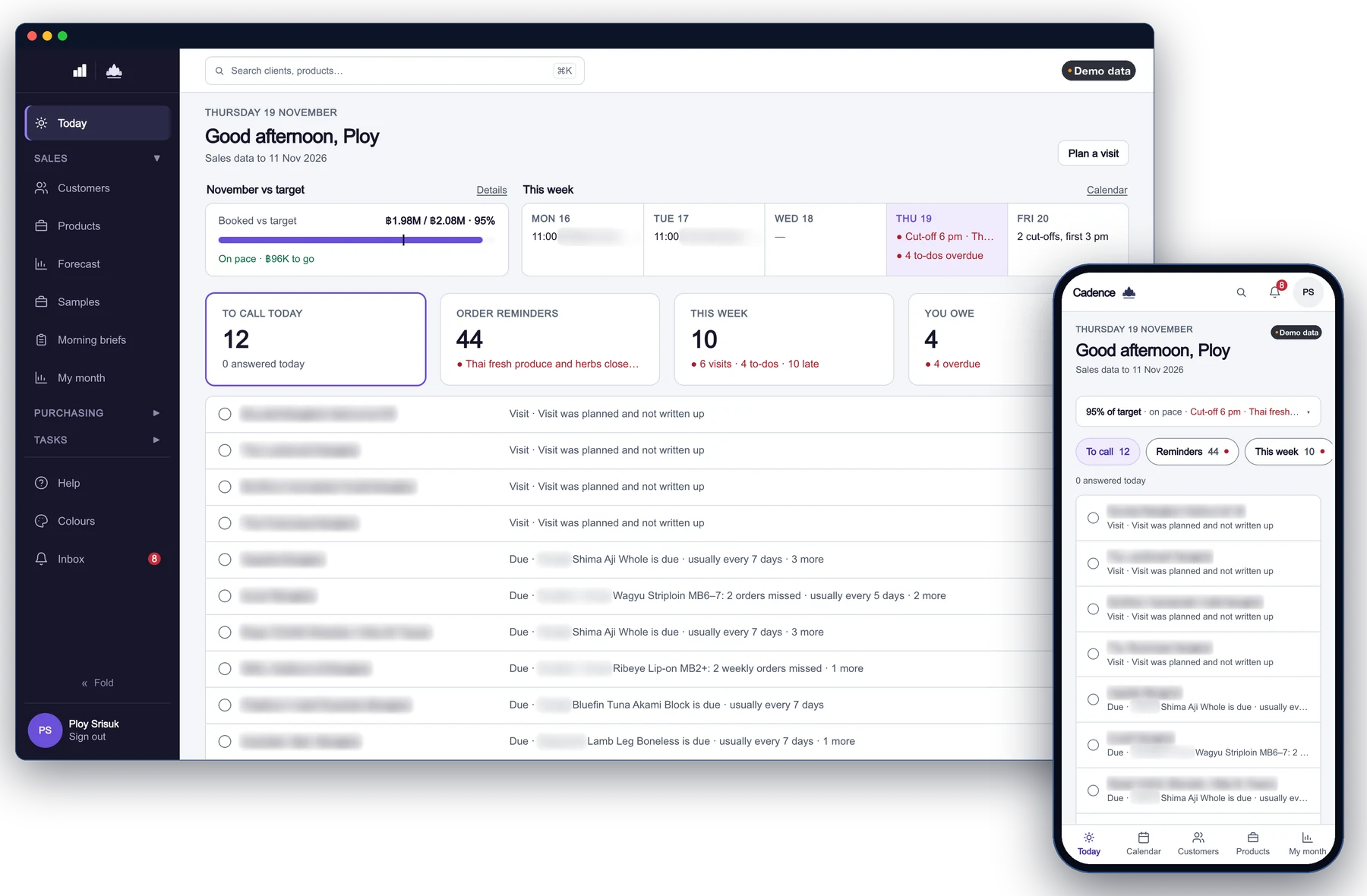
Cadence, the sales app we built, on a laptop and a phone: the Today screen with calls to make, order reminders, this week's visits and progress against the monthly target, with demo data.
Tools we built and run · demo data

Sound familiar?

Where the work gets stuck.

Pick your trade. These are the problems we hear most often.

Trade & distribution

  • Orders arrive by LINE, WhatsApp, email and phone, then get typed again.
  • Stock in the system does not match what was sold.
  • Sales reps visit without the customer's history in hand.
  • Month-end reporting is someone's two lost days.
More on trade & distribution

Food & beverage

  • A regular customer stops buying a product and nobody notices for weeks.
  • Purchasing guesses quantities; short-dated stock is written off.
  • Price exceptions agreed on a call are lost by the next invoice.
  • Visit notes live in one rep's head or phone.
More on food & beverage

Logistics

  • Delivery status lives in chat groups, so customers call to ask.
  • Proof of delivery is a photo somewhere in a driver's gallery.
  • Planning is a spreadsheet only one person can edit.
  • Billing waits for paperwork to come back from the road.
More on logistics

How we see it

Your ERP is rarely the problem. The gaps around it are.

We have run sales teams, distributors and operations ourselves. We build the tools we wished we'd had.

  1. The gaps cost more than the tools.

    The cost sits between systems: the same order keyed in twice, two stock figures that disagree, a customer history nobody else can see. We close those gaps rather than sell you another system.

  2. Tools should fit how you work.

    We build around how your team already sells, buys and delivers, in Thai or English. Your people should not have to bend their day around the software.

  3. Small steps, no lock-in.

    You commit one stage at a time, each priced before it starts, and nothing ties you to the next. Once a tool is live, we keep running it.

What we do

Four ways we close the gaps.

Pick the one that matches your problem, or let the diagnosis decide.

See it work

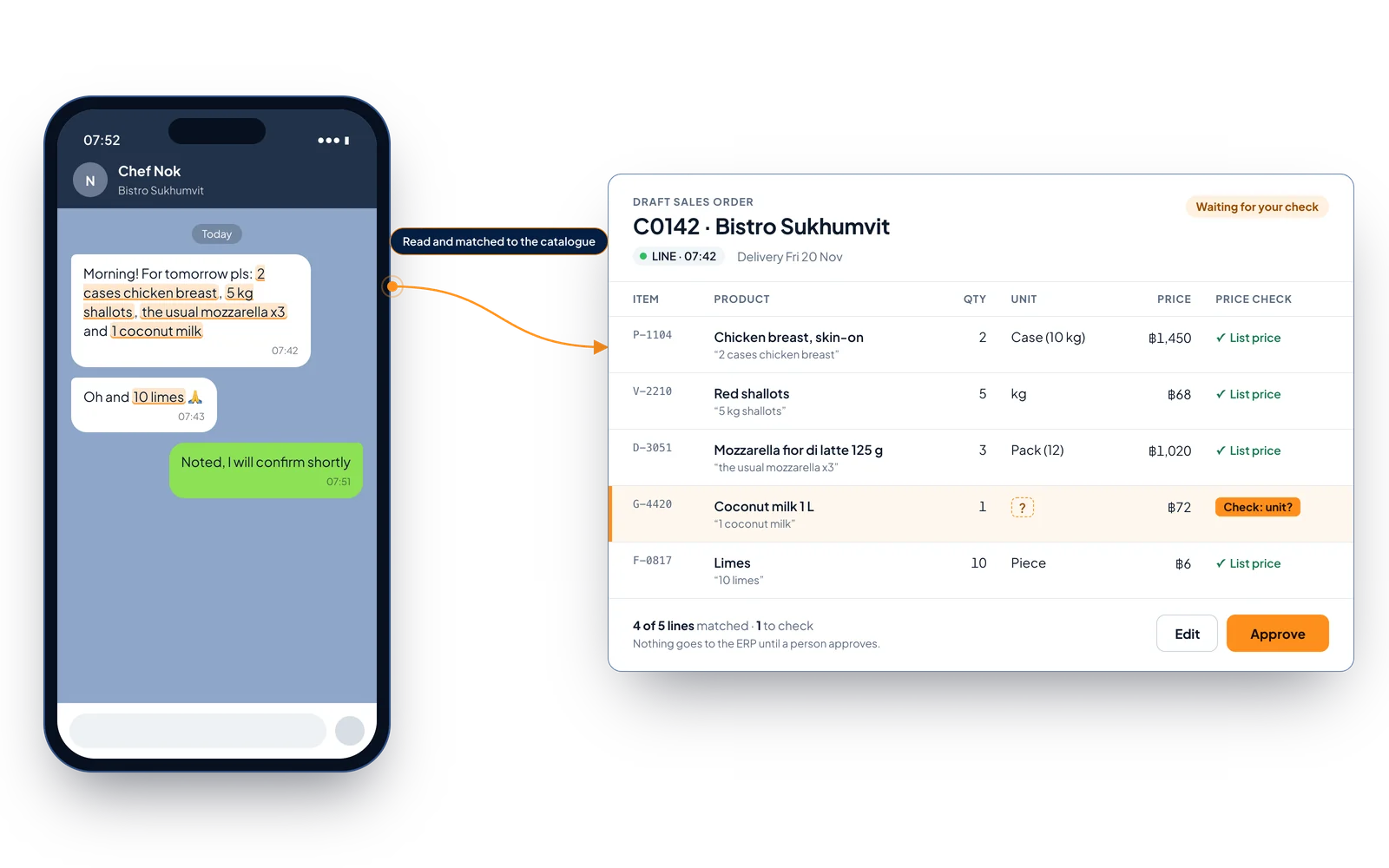
From chat to ERP lines, checked by a person.

Three messages in, order lines out, matched to your product list. Nothing reaches the ERP until someone approves it.

A LINE message from a customer next to the order lines drafted from it: customer, products, quantities and units matched to the product list, one line flagged to check its unit, and an Approve button. Demo data.
Order lines drafted from a chat, approved by a person · demo data

Proof you can open

Tools we built and run.

Proof, not a catalogue: each one started from a problem a business had, and we still run it. Screens are shown with demo or anonymised data.

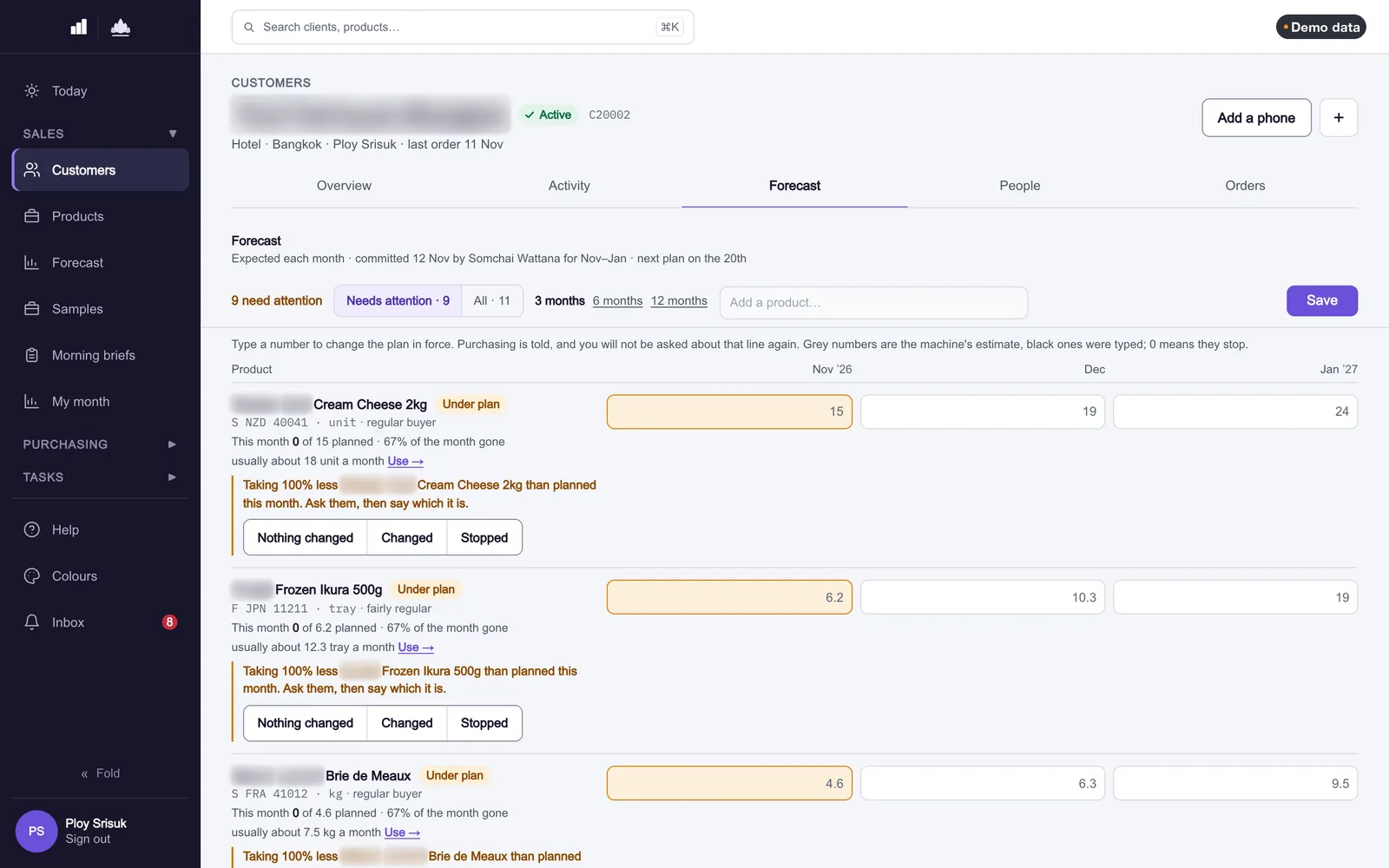
Cadence forecast for one customer with demo data: product lines under plan, each with the choice Nothing changed, Changed or Stopped. Customer and brand names are blurred.

Sales CRM · Food & beverage distribution

Regular customers quietly stopped buying products, and nobody noticed for weeks.

What we built: a sales CRM that reads the ERP's sales export and gives each rep a working day: who to call, which product lines are overdue, what was promised. Purchasing buys from the reps' plans.

See what Cadence does

Bring an ERP export and see Cadence on your own data.

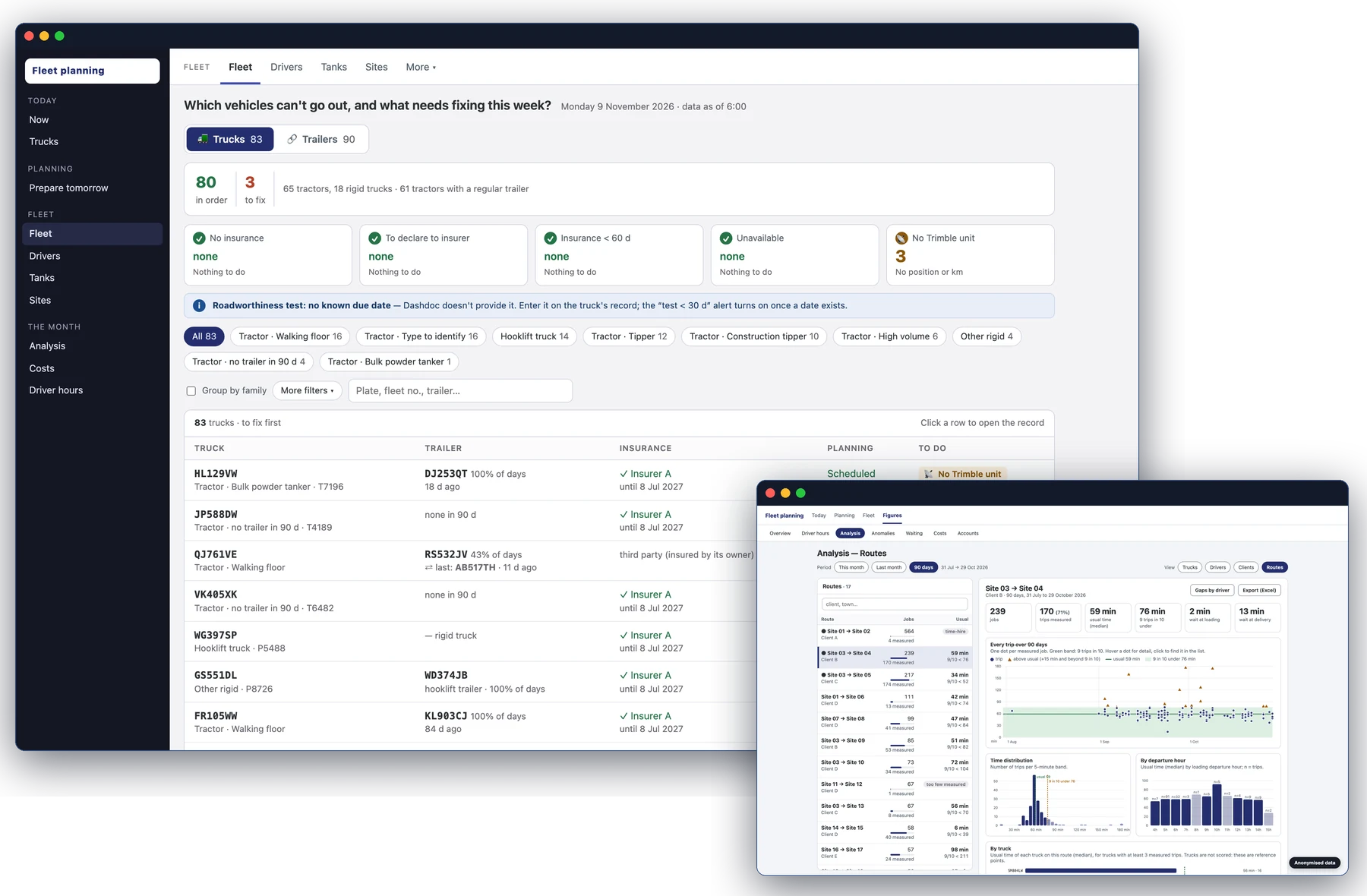
Two screens from the fleet-management tool: the fleet view listing trucks, trailers, insurance and missing telematics boxes, and a route analysis with trip times over 90 days. Names and plates are anonymised.

Fleet management · Transport, about 80 trucks

Tomorrow's rounds were planned across four tools that didn't talk to each other.

What we built: one fleet-management tool joining Dashdoc, Trimble telematics, the tachograph and Odoo, so planners see which trucks can't go out, review yesterday's trips and track route times and costs.

Fleet management for logistics
Jodrot logotype: a J whose bowl cradles a wheel, next to the word Jodrot.

Rental management · Motorcycle rental, Thailand

After an accident or a theft, nobody could say quickly who had rented which bike.

What we built: a registry for rental motorcycles, starting on Koh Tao. Shops register every bike, its documents and reminders, and run a 60-second rental checkout that captures the rider's passport; officials look up any bike by plate, VIN or passport after an accident, a theft or at a checkpoint. In English and Thai.

How we work

The Order-Flow Diagnostic.

One to two weeks. We follow a handful of real orders from the first message to the invoice in your ERP, and sit with the people who handle them on the way.

Fixed price, agreed before we start.

  1. Start here

    Diagnose

    1–2 weeks · fixed price

    You get: a ranked list of fixes and the first one scoped.

  2. Design

    1–3 weeks

    You get: clickable screens, a fixed scope and a fixed price for the build.

  3. Build

    4–12 weeks

    You get: a working tool on your real data, with a demo every week.

  4. Run

    monthly

    You get: support, check-ins and the next piece when the first one pays.

Stop after any stage. Each stage ends with something you can use, even if you go no further.

Book a 30-min call

Insights

Notes from the work.

All insights

FAQ

Short answers before you call

Which ERPs do you work with?

We start from the system you run: SAP Business One, Odoo, local accounting software or plain Excel exports. We read its data and, where it makes sense, write back to it. Tell us the system on the first call and we will say what is feasible. We are not an SAP or Odoo reseller.

Do we have to replace our current system?

Usually not. Most of our work connects the ERP, the LINE chats and the spreadsheets you already use, and adds the missing piece. If replacing something is the right answer, the diagnosis says so and explains why.

What does a project cost?

The diagnosis is a small, paid stage with a fixed price agreed before we start. After the design stage you get a fixed scope and a fixed price for the build. You can stop after any stage.

How long before we see something working?

The diagnosis usually takes 1–2 weeks and design 1–3 weeks, with clickable screens. A build usually takes 4–12 weeks, with a demo on your real data every week.

Contact

Tell us where the work gets stuck.

A 30-minute call with us. You describe how one order moves through your company today; we tell you plainly what we would change first, and whether we are the right people to do it.